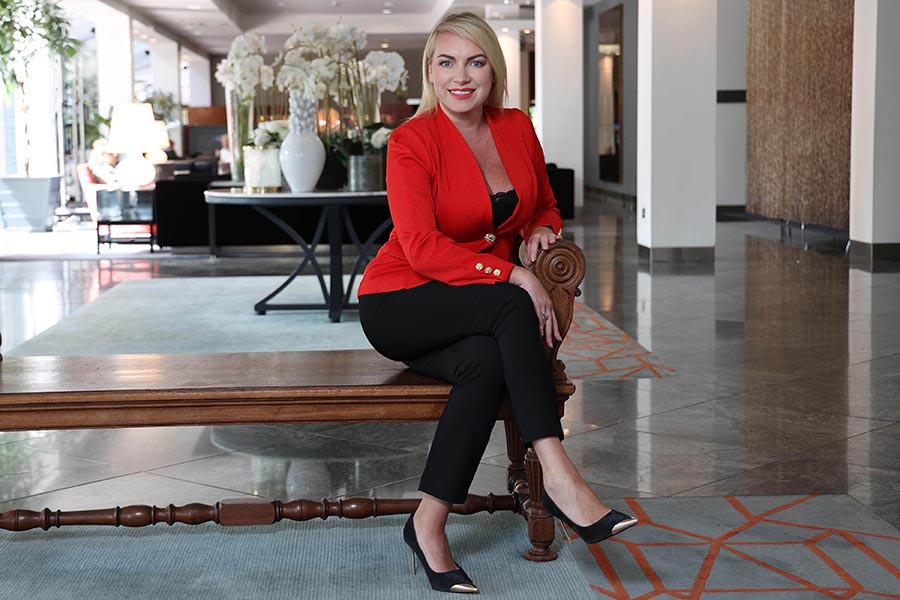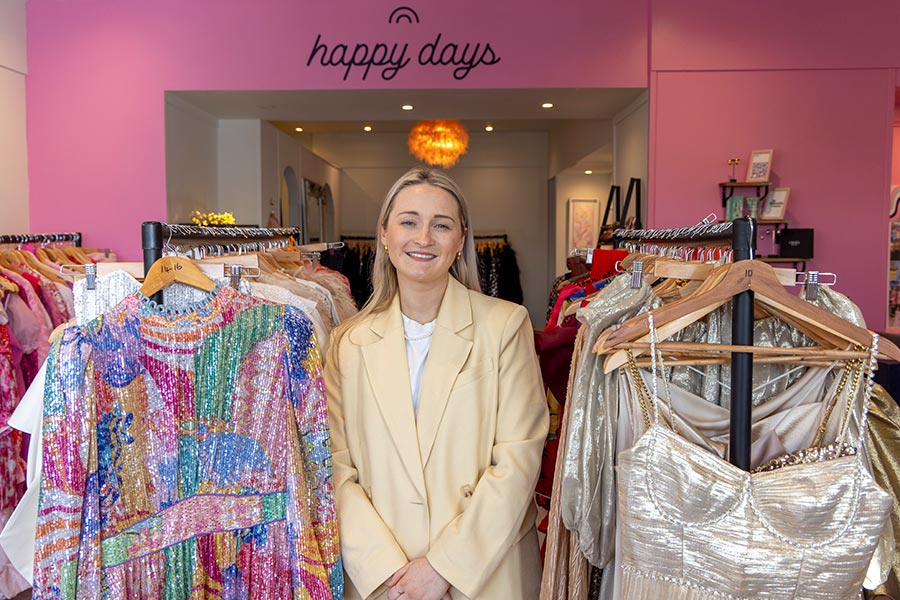
Entrepreneur, accountant and former KPMG and Google employee Rachel Hennessy tells Niamh Donnelly how her disillusionment with fast fashion was the inspiration behind her luxury dress rental company Happy Days
At the end of an avenue of pebbledash semidetached houses in Dublin’s Leopardstown, between a barber shop and a nail salon, sits a storefront as cheery as its name suggests.
Happy Days, the brainchild of former KPMG and Google employee and trained accountant Rachel Hennessy, is one of several luxury dress rental companies to have sprouted in Ireland in recent years.
Hennessy launched the business in 2021 after becoming disillusioned with fast fashion and wanting to provide an antidote.
“Like so many business stories at the moment, it started during Covid,” Hennessy says. “I started questioning my own shopping habits of buying from fast fashion brands, so I started to buy my own clothes secondhand — using [clothes resale platforms] Depop and Vestiaire, and those kind of apps.
“When I was doing that, I saw there was just so much occasion wear for sale — [items that] might have been worn once, or some that had tags on, never worn.”
Hennessy and her friends were of the age where weddings had begun to fill the social calendar.
She identified her target market as women in their thirties, who similarly had a lot of weddings and occasions to attend, and who had money to spend on their outfits.
The problem her business would address was a practical one.
Many women, herself included, preferred to wear a dress only once.
After it had been shared on Instagram, it became redundant. A rental model was far more sustainable — the dress could be worn many times, by different people.
And customers could wear designer pieces for a fraction of the retail price.
A number of luxury dress rental stores had begun to spring up in the United Kingdom, so Hennessy went over and tested them.
At home, she set up focus groups with friends, and friends of friends. She sent out surveys via WhatsApp to gauge what was important to people.
“The biggest thing was I really wanted a permanent location that people could go and try stuff on,” she says.
“I felt that’s what was missing in Ireland at the time. And I wanted to know where people would be willing to go, because I think it’s not your typical retail environment.
“You’re dropping off, collecting — you’re not going to leave on the day with the item you’ve ordered — you’re ordering it for a future event.”
The focus groups wanted one thing: free parking. So, Hennessy set out to find a kerbside location.
For capital, she pulled together some personal savings, and cashed in Google shares she had acquired while working there.
Inventory was purchased from both new and secondhand sources.
“We really wanted to try and get as much as we could second hand but we also wanted to have a good range of sizes and it’s harder to get above a size 16 secondhand,” she says.
“So, we did have to buy a few [dresses] straight from brands. But the majority was Depop and Vestiaire and buying from, say, customers, if they had stuff to sell.”
Happy Days opened its doors in December 2021.
“We didn’t do a big party or anything like that. Because this was my first time ever opening a business, I was very much softly going into it.
“A week after we opened, [Covid] restrictions came back in, and weddings got cut by half. So, it was a funny time.
“People had rented stuff — they were going to weddings — and things shut down again. At the time it was kind of stressful but, in hindsight, it was not a big deal at all.”
The happy-days.ie website launched the same day as the store. The Instagram page @happy.days.style had been set up five weeks earlier, and had built a following of around 5,000.
At the time of writing it has 55,000 and counting, and is where a large part of the Happy Days customer base comes from.
The bricks-and-mortar store, meanwhile, is what Hennessy describes as a “destination location”.
“People will come from Cork, will come from all over the country to try stuff on, especially ahead of wedding season.”
On this January afternoon, the space is warm and inviting, with dresses arranged by colour, and pink branding providing a contrast to the grey day.
The lush fabrics and designs of Alexander McQueen, Self-Portrait, Rebecca Vallance, Karen Millen, Nadine Merabi and more hang proudly on the racks.
On a rail near the door are fur coats, along with a recent, very successful, addition to the inventory — ski wear.
At the back, a woman tries on one of the more popular dress rentals of the season, a sparkly number by Spanish designer Celia B.
If this woman chooses to rent this dress, she will book a threeday slot, during which the dress is hers.
It will be delivered to her, and collected from her, by couriers (or she can choose to collect and return it in-store). Cleaning is covered by Happy Days — they use a “wet cleaning service” which is more environmentally friendly than dry cleaning.
Prices range from €30 to €250, depending on the dress. The amount of uses a dress gets also depends on the garment.
“We have some dresses that we’ve had from the very start that are in perfect condition,” Hennessy says.
“Sometimes, a dress might get 15 wears and then could be at the end of its life.”
At this stage it will go up for sale on the website, prolonging its life further.
But while Happy Days was set up with sustainability in mind, it’s also part of a rapidly growing market.
Between 2016 and 2023, the global apparel rental market had more than doubled in size from $2.6bn (€2.5bn) to $6.2bn (€6bn), according to statistics from GlobalData, a UK data analytics and consulting company.
Hennessy feels that attitudes towards dress rental are shifting, and that “it’s becoming the new norm”.
But she also points out that the app for online megastore Temu, was the most downloaded in America last year — in other words, fast fashion is still a burgeoning force.
When it comes to growing Happy Days, Hennessy has no plans to open a second location but rather sees potential for expansion in the online store.
From an original inventory of 350, she has expanded its stock to “800 dresses and growing”, and sizes that range from 4 to 26.
A recent innovation is the “managed rentals” branch of the business.
Happy Days rents out dresses on behalf of other people, including influencers such as Holly Carpenter, Chupi Sweetman, Kate O’Neill, Louise McSharry and many others.
“We’re growing that part of the business,” Hennessy says. “It means we don’t have to invest in any stock.
“We’ve tripled our stock this year purely from doing that. It’s not just influencers, it’s customers who give their dresses too.
“And then, every quarter, they get a report, and a payout based on how many times their dress is rented.”
Fostering a community atmosphere and cross-collaboration with other brands are central to Hennessy’s outlook.
Recently, she partnered with Vision Ireland Retail to run a pop-up at Electric Picnic.
In February, she plans to have a ‘female founders’ series, where each weekend a different female-owned business will pop up in-store.
“I feel with clothing brands, it’s becoming so much more about community,” she says. “What we’ve done in Happy Days since the start is have events in the store and different things like that.
“You can meet customers more. There’s so much online at the moment ... I think it’s important to be able to connect with customers in that way.”
Last year, Hennessy launched the Happy Days podcast.
“If you’ve listened to it, it’s not about dress rental, it’s about the happy days in people’s lives. But the odd time secondhand fashion stuff comes up — and that’s what I really like, when conversations come around [to] that stuff really naturally.

“So, it’s not to promote the business, it’s kind of separate, but it does mesh in with it a bit.”
Hennessy’s success has been fostered by initiatives like the Going for Growth programme (which supports women founders) and a mentorship provided by her local enterprise office.
She would advise fledgling founders to seek support from enterprise offices and mentorships where they can.
“The first year in business, we over-achieved our targets. I think it was just way bigger immediately than I thought it was going to be. Which was amazing, because we’ve only grown since then.”
But Ireland’s high Vat rate has been one of the biggest challenges she has faced.
“There’s no tax incentives or tax breaks for a business that’s trying to be involved in a circular economy,” she says.
“It’s 23% on secondhand clothes as well. So even when we sell stuff on, it’s 23%.
“It’s just not giving any of these businesses incentives to grow. Ireland is welcoming the new global European office of [fast fashion brand] Shein, and then all these small Irish businesses are trying to make a difference, somehow, in this circular economy, and getting absolutely nothing for it.”
Photo: Rachel Hennessy of Happy Days