Every week, Amárach and Future Proof Insights share exclusive findings from their PRIZM+ ad testing service, showcasing best practice creative advertising in Ireland.
Bank of Ireland’s latest spot trades in high-energy humour, framing everyday banking through the lens of absurd adventure.
Two friends bungee-jump, face giant spiders, and even cross paths with a mischievous monkey, all while one calmly worries about his lost bank card.
The reason for his state of calm...A simple tap on the Bank of Ireland app to freeze it.
The creative uses spectacle and comedy to convey the brand promise of security: “Simple, Seamless, Secure.”
From a brain-response perspective, the ad keeps viewers engaged and lifts emotion at the right comedic beats.
Motivation and memory encoding are strongest when the app feature is introduced and when the product benefit is reinforced in the closing frames.
For its younger audience, the ad effectively pairs reassurance with entertainment, making banking functionality memorable in an unexpected way.
Overall, mental effort stays in a healthy range, memorisation is particularly strong, and the ad works through short bursts of attention and emotion rather than long sustained highs.
These bursts line up with the big comic moments, ensuring the brand message is encoded when it matters most.
The creative cleverly leverages the interplay of a few different dimensions to drive this response, such as conceptual closure (reward when the story comes together), benign violation (humour that feels safe and entertaining), and novelty bias (the brain’s heightened response to rapid new information).
Best Performing Scenes
0:17 - 0:22 – Photo Montage
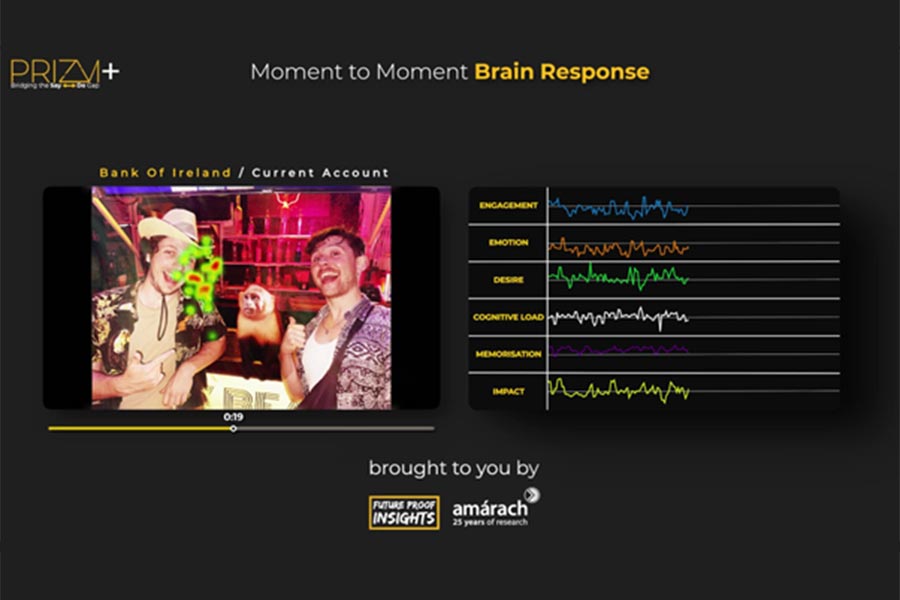
This sequence creates one of the ad’s strongest lifts.
Engagement, emotion, and desire all rise as viewers are rapidly presented with snapshots of the friends’ antics, smiling with a monkey, upbeat music, and even a tattoo reveal.
The fast-cut montage plays on novelty bias and empathic simulation.
Empathic simulation is the brain’s tendency to mentally step into the shoes of others, in this case, viewers temporarily feel like they are part of the carefree fun with the monkey and the friends.
That sense of living in the moment makes the humour more engaging and the memory stronger.
For Bank of Ireland, it’s a moment where entertainment primes the brain, ready to land the product benefit that follows.
0:33–0:37 – Monkey at the Market
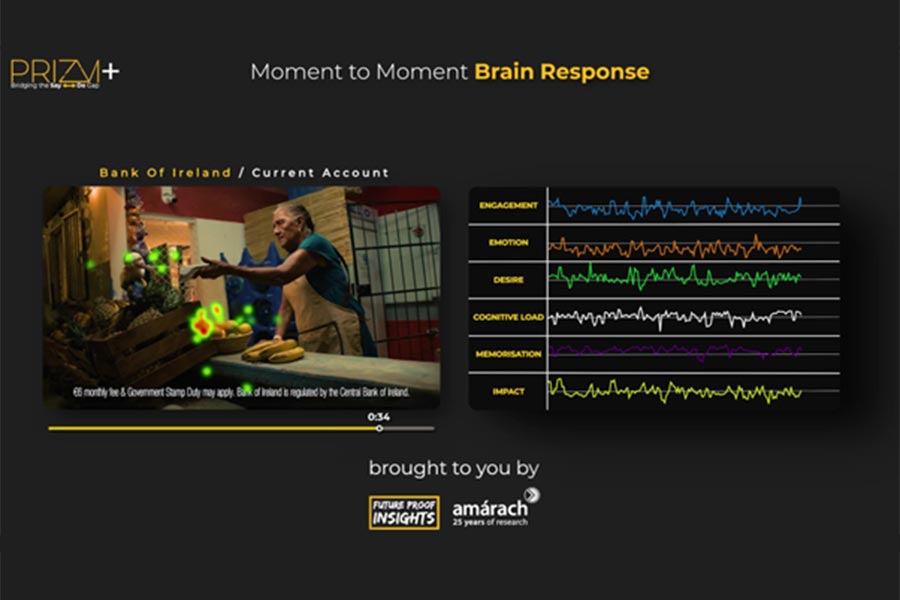
The mischievous monkey tries to spend the card at a banana stall, only to be declined. Engagement and impact both rise here, with memorisation also strong as the narrator explains: “Relax, with the Bank of Ireland current account.”
By turning the payoff into a humorous resolution, the ad achieves conceptual closure.
The brand benefit is both understood and felt, anchored in a moment of relief, reinforced by the audience’s heightened response when the monkey attempts to use the card.
This also taps into the recency effect, with the brand linked closely to the final joke.
Underperforming Scenes
0:13–0:16 – Spider in the Cave
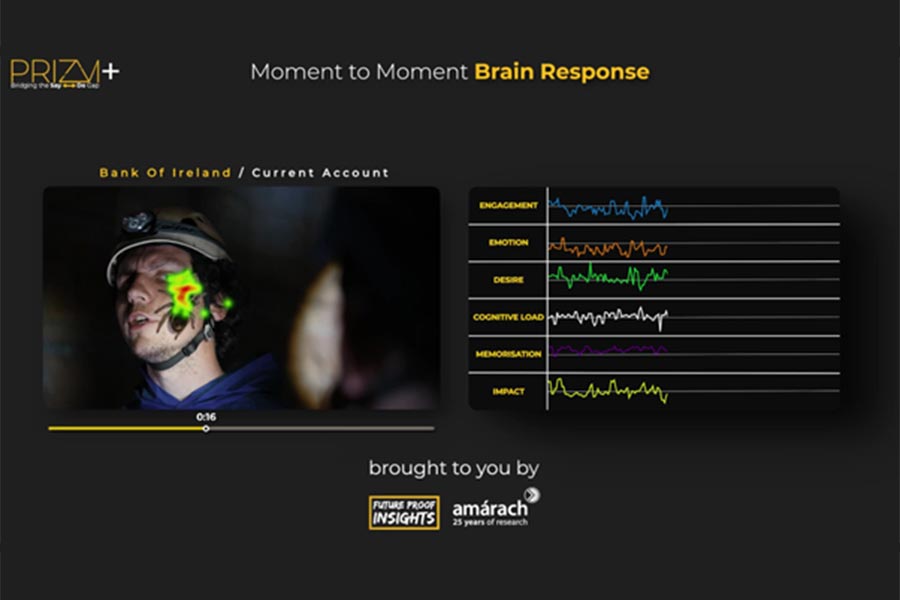
The visual gag of a giant spider lands as comic absurdity, lifting emotion. Yet with no brand presence, the moment risks being a disposable laugh.
The audience reacts, but doesn’t attach it to Bank of Ireland.
This is an example of emotional flatness from a brand perspective, a reaction without lasting association, highlighting a gap where subtle brand cues could have reinforced the connection.
Behavioural Impact (COM-B)
Survey results point to a generally positive behavioural impact.
Motivation is strong, meaning younger viewers in particular felt more compelled to act after seeing the ad.
This is especially true for 18–24 year olds, the exact target, who came away more energised by the message.
People who had seen the campaign before also responded more positively, showing that repetition builds confidence in the brand.
The product benefit was understood easily, which reflects strong capability, but the sense of opportunity felt less relevant for some.
In practice, younger audiences connected most with the humour and reassurance, while older viewers and those in Dublin were less likely to see the ad as directly relevant to their own lives.
Final Thought / Lessons for Marketers
Key lessons emerge from this creative.
First, wrapping reassurance in ridiculousness transforms a dull but important product feature into something people actually want to watch.
It makes the serious point, security, land with a smile.
Second, the ad shows that product functionality works best when it is revealed at the high points of the story, the moments of humour, surprise or relief, because that is when people are paying the most attention and are open to remembering it.
Third, humour needs an anchor. Jokes without brand cues risk being forgotten as just another funny moment, while jokes tied back to the brand build both entertainment and recall.
Finally, the ad highlights how pairing security with surprise can be powerful.
It tells marketers that even in categories seen as dry, blending reassurance with playfulness keeps viewers engaged and makes the brand message more likely to stick.
For more insights from PRIZM+ on how neuroscience drives advertising impact, visit: https://www.futureproofinsights.ie/prizm-plus/