The CX-80 is luxurious and quiet with deep reserves of torque thanks to its oil-burner engine, making a strong case for it over the PHEV version, writes Philip Nolan
We’ve been told all too often that diesel is dead, a legacy fuel that pretty soon will work its way out of the passenger car market.
The figures bear it out, with only 18.36 per cent of new car registrations this year having diesel or diesel hybrid powertrains.
In the early part of the last decade, that was close to 80 per cent.
Well, says Mazda, hold my beer, because not only is there life left in it, we’re actually going to equip our new SUV with as good a diesel engine as you’ll find anywhere.
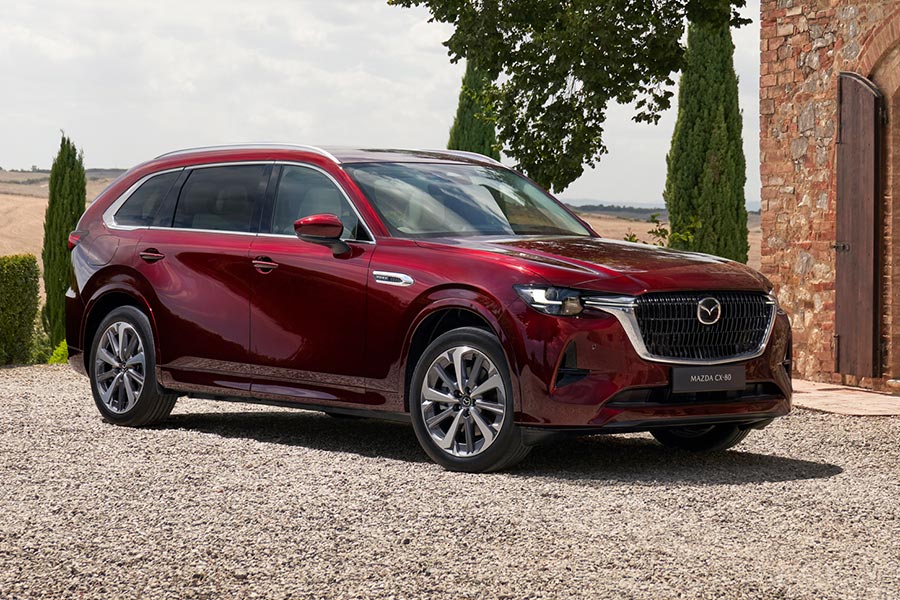
The car is the new flagship CX-80, available with six or seven seats, and it is quite stonkingly good, a beast of a thing that has enormous presence — at almost 5m long, literally enormous — while also somehow managing to remain visually appealing.
Let’s start with the engine, a sixcylinder inline unit with 48v mild hybrid assistance that produces 251hp, which propels it from 0-100kph in 8.4 seconds.
That’s tidy, but not sparkling, though that isn’t really the point.
Where it scores is at steady speeds on longer runs, producing seamless power and remaining whisper quiet with it.
Long gone are the days diesel engines could wake Eamon Ryan.
The car comes with rear wheel-biased all-wheel drive, and the Mi-Drive system offers selectable modes, namely normal, sport, offroad and towing.
The performance is not quite as good as the petrol plug-in hybrid version, which will hit the ton in 6.8 seconds, and which also is cheaper at every trim level.
Colleagues who have driven both say they still prefer the diesel just for its terrific torque.
I’ll try to get into the PHEV later in the year, which as things stand is proving pretty crowded for new models.
As for the seats, well, there probably is a relatively small market for seven seaters now, though anyone who regularly has to shuttle not only their own children but their children’s friends too probably would see one as a godsend.
The configuration is the standard 2/3/2 layout, and the rear two really are suitable only for smaller children, though the middle row also slides forward so you can even out the available legroom.
If you wish, you can order the car with six seats, in which case the middle row is two captain chairs rather than a bench, which also leaves a gap for easy access to the back row.
If that isn’t important to you, you can order a console between those two middle seats. The downside of having all seven in use is cargo space, which is just 258 litres, on par with your average supermini.
However, if you drop the rear two, you open up 687 litres of load capacity, and if you drop the middle row too, you’re looking at a whopping 1,221 litres to the window line, and 1,971 litres packed to the roof.
You’d probably fit an entire room of flatpack furniture in there.
As for those seats, well, my test car came in the top spec, Takumi Plus.
The upholstery is beautiful white leather, with heated and ventilated seats up front, and a heated steering wheel too.
There’s lots of cabin storage space, and plenty of leg and shoulder room for five, with only that back row a little more restricted.
There are phone charging points at all three rows, including a wireless charge pad up front.
Apple CarPlay and Android Auto are compatible, but the car also comes with built-in Amazon Alexa in-car voice control.
Depending on the grade you opt for, the sound system is either Mazda’s own or Bose.
There were a few features I really, really liked.
The head-up display is perfectly sized for someone who, like me, needs glasses for reading, not for driving.
Everything on it is totally clear and readable.

The other standout feature is superb auto-dimming headlights, which are among the most responsive I’ve seen, lowering the high beams when even a pinprick of light is detected ahead. In my part of the country, where many of the back roads are unlit, they were a godsend in the face of approaching vehicles.
The big issue with the car, though, is price. The petrol PHEV in Exclusive Line trim starts from €62,380 ex-delivery, but the diesel version in the same trim level costs €73,940, and my Takumi Plus, with all the bells and whistles, is €81,990.
That’s a lot of money, no matter what way you slice it.
Yes, the CX-80 has luxury brand build quality, and I loved it, but that premium for the diesel surely will see more demand for the PHEV.
Pity, because diesel isn’t dead yet.