Increasing business costs, lower occupancy levels and growing global economic and political uncertainty are among the most pressing concerns for hoteliers ahead of Monday's Irish Hotels Federation (IHF) annual conference.
Research carried out by the IHF recently shows a drop in business levels within the sector, with average national hotel room occupancy falling from 76% to 74% last year.
There remains a significant disparity in average occupancy levels across the regions, ranging from 70% in the border region to 81% in Dublin.
Business sentiment among hoteliers for the year ahead is down for a second year running, with 37% of hoteliers reporting a positive outlook for trading conditions over the next 12 months.
This contrasts with 47% who reported a positive outlook this time last year and 74% the previous year.
Compared to the same time last year, hoteliers are reporting a further drop of 2% in business levels on the books for 2025, equivalent to €100m in bookings.
While results indicate that the domestic market and North America are holding up so far, hoteliers are reporting a net drop in bookings from Britain, Northern Ireland and the Rest of Europe.
Michael Magner, president of the IHF, highlighted exceptional increases in operating costs over the last three years eroding profitability, particularly for smaller hotels with less than 100 rooms that are more reliant on food and beverage sales.
"Last year was very difficult for many businesses within our sector due to what can only be described as relentless increases in the cost of doing business," said Magner.
"This has been a persistent challenge for hotels and the wider hospitality industry since 2022 with no let-up in sight.
"The situation has been compounded by the decision to increase the rate of hospitality VAT, which has hit food service businesses particularly hard. It is therefore very welcome that the government has committed to revisiting the VAT issue as part of the budgetary process.”
Hoteliers continue to rank rising costs as the most serious challenge facing their business, but the wider economic environment is also a growing concern.
Some 94% of hoteliers say they are worried about the global economy and the potential impact of political uncertainty in key markets.
A further 78% of hoteliers say they are concerned about the outlook for the Irish economy over the next twelve months, with consumer finances under pressure and international developments posing risks to the Irish economy.
“The government, in partnership with the industry, has a pivotal role to play in creating a more positive business environment for enterprises throughout our sector,” said Magner.
“There is a lot more that the government can do to assist businesses in labour intensive industries such as our own. The strong focus on tourism within the Programme for Government is of course very welcome and a vital first step to putting Irish tourism and hospitality on a firmer footing.”

“Having recently met with Minister Peter Burke to discuss the priorities for the development of our sector, we are more optimistic about the immediate and longer-term prospects for our industry.
"In particular, we believe that the recent repositioning of tourism within the reconfigured Department of Enterprise will facilitate a more joined-up and coherent approach to best support businesses within our sector."
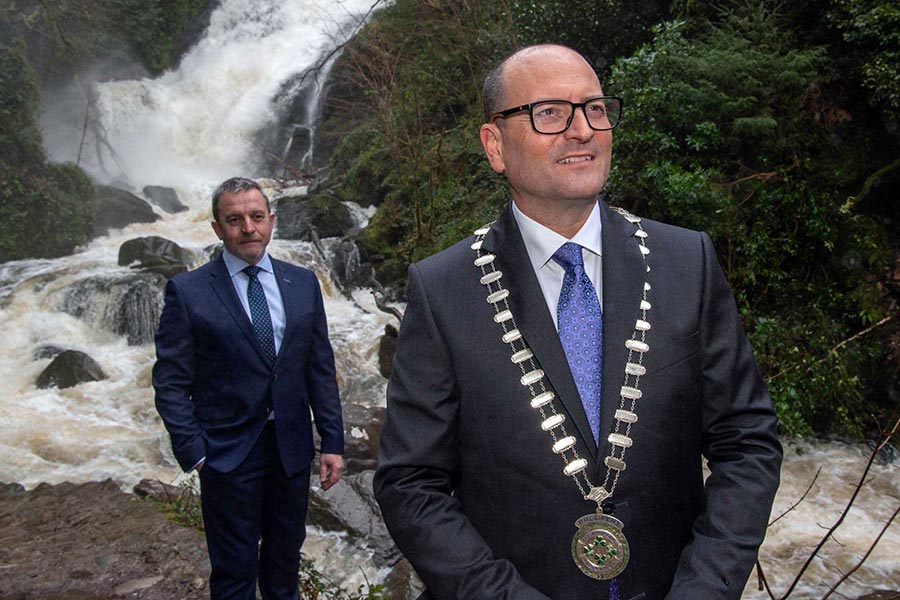
Photo: IHF President Michael Magner on right with IHF Chief Executive Paul Gallagher pictured on arrival in Killarney on Sunday ahead of the annual Irish Hotels Federation Conference. Photo: Don MacMonagle